VEHICLE ENERGY
100.46 kWh CATL traction battery
The FOTON eAUMARK 100 truck’s traction battery supports vehicle propulsion. The listed drive motor peak power is 150 kW and the vehicle configuration is 4×2.

BLUECURRENT · EV MOBILE CHARGER
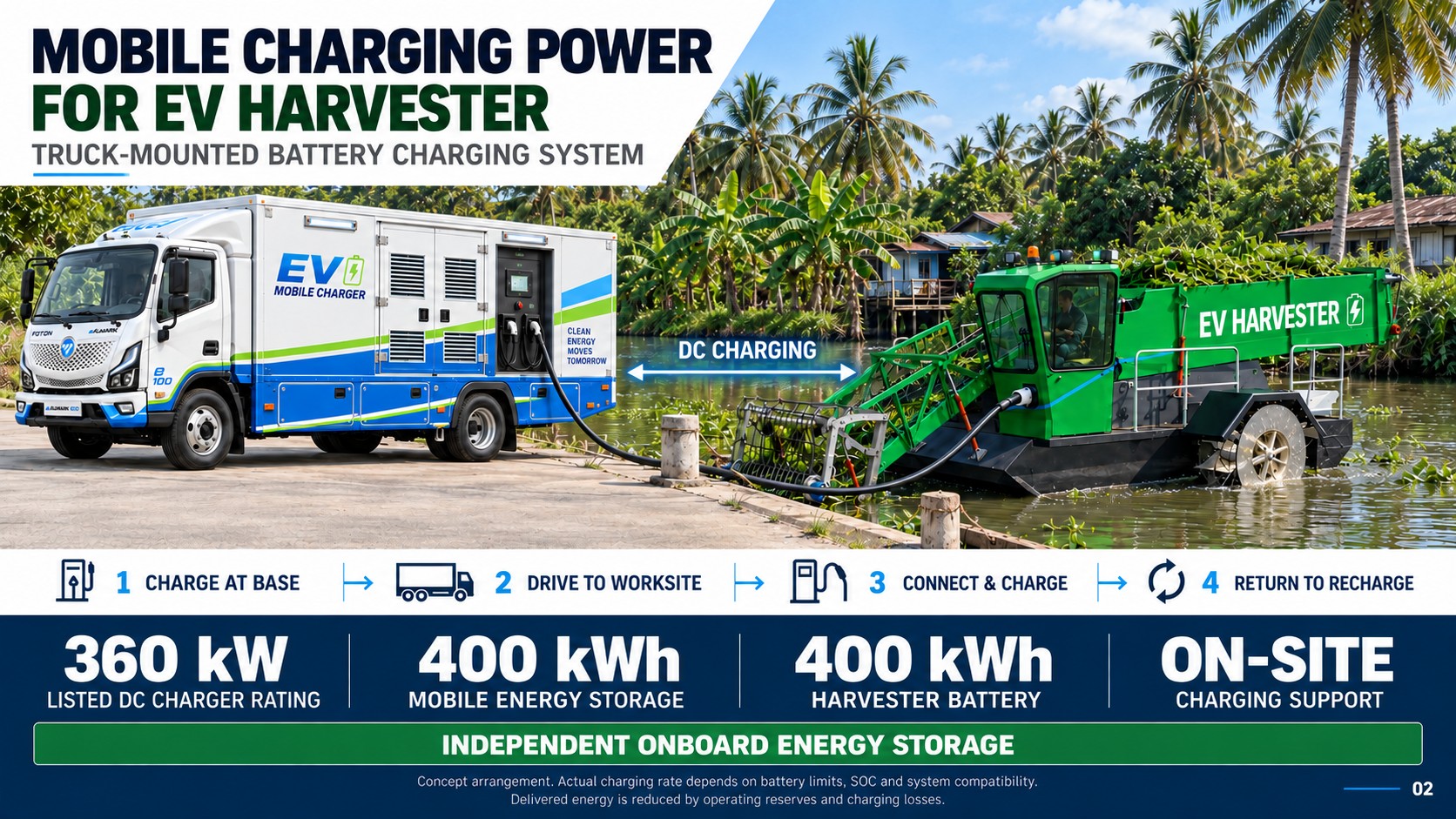
A mobile energy concept for electric vessel operations: an enclosed charging system carried by a FOTON eAUMARK 100 electric truck, with a dedicated energy store separate from the truck’s traction battery.
TWO BATTERIES. TWO ROLES.
The concept distinguishes the vehicle’s propulsion energy from the energy available for customer charging. These capacities must not be combined as one usable charging figure.
VEHICLE ENERGY
The FOTON eAUMARK 100 truck’s traction battery supports vehicle propulsion. The listed drive motor peak power is 150 kW and the vehicle configuration is 4×2.
CHARGING ENERGY
A separate onboard energy store supplies the proposed DC charging system. Usable energy delivered to a vessel is lower than nominal storage capacity after reserves, conversion losses and operating limits.
*360 kW is the listed charger rating, not a guaranteed continuous transfer rate. Actual charging power depends on the source battery, vessel battery acceptance, state of charge, voltage, connectors, thermal conditions and approved system integration.
ENCLOSED BODY CONCEPT
The current concept focuses on an organised, serviceable enclosure with equipment access and cable handling built into the body layout.
Louvred service areas are shown in the enclosure concept. Airflow, cooling duty and weather protection require detailed integration design.
Controls and charging cable docks sit within dedicated body recesses to keep the operating interface organised and accessible.
Lower storage is included in the concept layout. Final compartment loads and equipment placement must respect axle loads and the vehicle weight limit.
CONFIGURATIONS
The enclosed truck concept and the separate cabinet alternative are distinct configurations. Their power and energy ratings are not interchangeable.
| Specification | Enclosed truck concept | Separate cabinet alternative |
|---|---|---|
| Listed DC charger rating | 360 kW | 120 kW |
| Independent energy storage | 400 kWh | 210 kWh |
| Arrangement | Enclosed body on electric truck | Separate cabinet configuration |
| Design status | Integration concept; verification required | Alternative concept; project-specific integration |
The complete vehicle must be checked for body and equipment mass, axle loads, centre of gravity, mounting integrity and compliance with the 8.5 t gross vehicle weight limit. The stated chassis figure alone does not confirm carrying capacity for the charging system.
Battery voltage, charging protocol, connectors, electrical protection, emergency controls and thermal management also require compatibility review with the target vessel.
A nominal 400 kWh charging energy store does not promise a complete recharge of a 400 kWh vessel battery. No fixed one-hour charging time or continuous 360 kW delivery is guaranteed by these concept specifications.
OPERATIONAL WORKFLOW
Mobile charging is a planned service cycle, supported by suitable base charging, safe site access and confirmed vessel compatibility.
Charge the service energy module and truck as required. Confirm the planned delivery energy, travel needs and reserve allowances.
Use the confirmed access route and parking location, accounting for vehicle dimensions, ground conditions and waterfront restrictions.
Establish the work area and follow approved connection and operating procedures. Monitor the charging session within vessel and equipment limits.
Disconnect safely, secure the equipment and return to base. Record delivered energy and recharge for the next service cycle.
CONNECTED ELECTRIC OPERATIONS
Start with vessel energy demand, battery acceptance, available charging windows and site access. BlueCurrent can use these requirements to define a project-specific integration scope.
Our official partners
Electric power-system expertise and Thai shipyard capability, connected through BlueCurrent.